Research · Architecture papers

One truth. Many projections.

Eight short papers on a single idea: facts should live exactly once, and everything else, a dashboard, a feature table, a model, an answer, should be a view generated from them. This is the doctrine the world-model research on this site is built to respect.

Eight problems, one mistake

Every organization that runs on data eventually discovers the same eight problems. They surface as incidents, audit findings, model failures and arguments in conference rooms, and organizations usually buy eight products to solve them. The series argues they are symptoms of one architectural mistake, and it exists to name that mistake, state the principles that prevent it, and offer a vocabulary for reasoning about any system.

The mistake is confusing a representation of the truth with the truth itself. A dashboard, a feature table, a model’s memory, an AI’s answer, even an official conclusion is a view of the record, built for a purpose, and none of them may own the facts. When views own facts, the eight problems follow. When facts live once and every view is generated from them, the problems become structurally difficult to have.

The papers are a design doctrine, not product documentation, written so that an architect can evaluate the principles independently of any product. They move from recording reality to defending decisions: record the facts once, give them something permanent to attach to, keep what was reported distinct from what was concluded, make the past reproducible, hold every source to the same account, let AI reason without letting it execute, keep every model a view and never the record, and commit explicitly on a frozen basis.

None of the ingredients is new, and the papers say so. Append-only records, point-in-time data, materialized views, entity resolution and provenance are all established. The contribution is the combination: one set of principles under which operational systems, analytics, machine learning, human judgment and AI assistants all consume the same governed truth, and under which every claim can be traced to its evidence and to the actor who stands behind it.

One truth. Many projections. Every claim traceable, every source accountable, every decision defensible.

The mental model

From raw data to defensible decisions

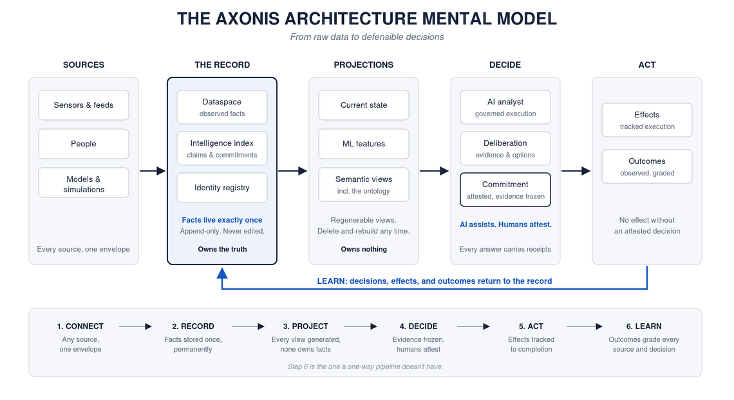
Sources feed one record; the record owns the truth and projects it into views that own nothing; decisions are made from those views; effects and outcomes return to the record.

The Axonis architecture mental model, from raw data to defensible decisions. Five columns run left to right: sources (sensors and feeds, people, models); the record, which owns the truth, where facts live exactly once and are append-only; projections such as current state, features and semantic views, which are regenerable and own nothing; decide, where an AI analyst assists and humans attest; and act, where effects and outcomes are tracked. A return arrow labelled learn carries decisions, effects and outcomes back into the record. Below, six steps: connect, record, project, decide, act, learn.
The architecture mental model. Facts are stored once in the record and everything downstream is a projection. The loop closes at the last step: decisions, effects and outcomes return to the record, which a one-way pipeline cannot do.

Featured · Paper No. 7

The Record Before the Model

The record precedes every representation. A model may represent the world; it may never become the record of the world.

World models, digital twins and agent memories are an ambition worth pursuing, and this paper is not an argument against them. It is an argument about a boundary that the ambition, left unexamined, always crosses: a representation is judged by usefulness and improves by revision, while a record is judged by fidelity and survives by refusing it. When one system serves both purposes, usefulness starts editing fidelity.

The paper keeps four worlds distinct and linked by provenance: the observed world (what sources reported, preserved as reported), the believed world (current attributed accounts of state), possible worlds (forecasts and counterfactuals, always marked), and the committed world (what an organization actually decided). A learned world model is then two familiar things and nothing more exotic: a consumer that trains on the record by replay, and a source among peers whose predictions enter the record as claims, graded as outcomes arrive. It is never the record. Collapse any pair of worlds and a specific failure follows, from a forecast cited as an observation to a model grading its own predictions from its own memory.

This is the paper behind the rewinds in our demo: they live in the possible world, and their results are claims relative to what the model has learned. See where the model sits.

The series

Papers 1 to 8, in brief

A one-paragraph summary of each paper. The summaries are all we publish here.

No. 1

One Truth. Many Projections.

Facts live exactly once. Everything else is projection.

Five systems giving five answers to one question is the symptom of duplicated facts. The source of truth is append-only streams of events, never edited: a correction is a new event that supersedes the old one, because what was believed at the time is itself a fact. Every other view, current state, features, semantic context, is a projection that must pass one test: can you delete it and regenerate it?

No. 2

Identity Is Infrastructure.

Identity survives labels.

People change names, hardware is swapped and providers assign their own identifiers, yet real-world things outlive everything written on them. A durable identity cannot be any of its labels, and what exists is declared in a registry, not inferred from whatever happens to report. Disagreements about what an entity is called, or whether two records are one thing, are evidence attached to identity, not changes to it.

No. 3

Evidence Before Interpretation.

Interpretation may change. Evidence must remain inspectable.

A source report is not reality: it records what a source reported, preserved faithfully with its source and time. A record becomes evidence only when it is selected in support of a claim, and the selection is attributable. When credible sources disagree, the disagreement is kept rather than averaged away. Conflict is data; resolution is judgment. Conclusions may be revised, but the evidentiary chain must not be.

No. 4

Replay Is Computation.

What was knowable must remain reproducible.

Treat the record as something to run, not only to look at. Two clocks, when a source says something applied and when the record accepted it, support two reconstructions: the best current account of the past, and exactly what was knowable at the time. Replay reconstructs knowledge state, not reality, and it reconstructs rather than hypothesizes. A counterfactual starts from reconstructed state and alters one thing deliberately, and must never be presented as a replay.

No. 5

Every Source Is a Peer.

Same envelope, same accountability.

A gauge, a technician, a model and a forecast all enter the record through one accountable envelope: who says so, about what, when, what kind of statement, and where it came from. Peer means accountable alike, not trusted alike. A calibrated instrument and an anonymous tip are not equals, but both are identified, both keep their kind, and both earn a scoped track record as outcomes arrive.

No. 6

Governed Semantic Execution.

The model plans. The substrate executes. The record holds both accountable.

A language model interprets ambiguous questions and composes answers better than any earlier technology, and is not a reliable engine for exact arithmetic, exhaustive retrieval or temporal ordering. The doctrine divides the labor: the model proposes, the substrate carries out the exact work, and the answer that comes back is bound to the evidence it rests on. The aim is fluent answers that can say what they stand on, and say plainly when the record holds nothing.

No. 7 · Featured

The Record Before the Model.

A model may represent the world, never become the record of it.

Four worlds, observed, believed, possible and committed, stay distinct and linked by provenance. A world model, digital twin or agent memory is a consumer of the record and a source of claims within it, valuable exactly until someone treats it as the record itself. Read the featured summary above.

No. 8

A Decision Is a Commitment.

A decision is a commitment, not a conclusion.

A conclusion is a claim and can be revised. A decision binds an accountable actor, under a valid authority, to a chosen course on a stated basis, and that basis is frozen when the decision is made. Its effects are tracked, and its outcomes are observed separately. Decision quality is judged by what was knowable at the time, not by luck, so an organization can stand behind what it decided, not just store what it saw.