Event-driven world models
The world runs on events
A world model worth having should learn how the world works by watching it, predict what happens when we act, and be able to tell us why. We built an event-driven world model of San Francisco from the city’s own records and tested it on a day it had never seen: 20 December 2025, when a fire at a single substation left a third of the city without power.
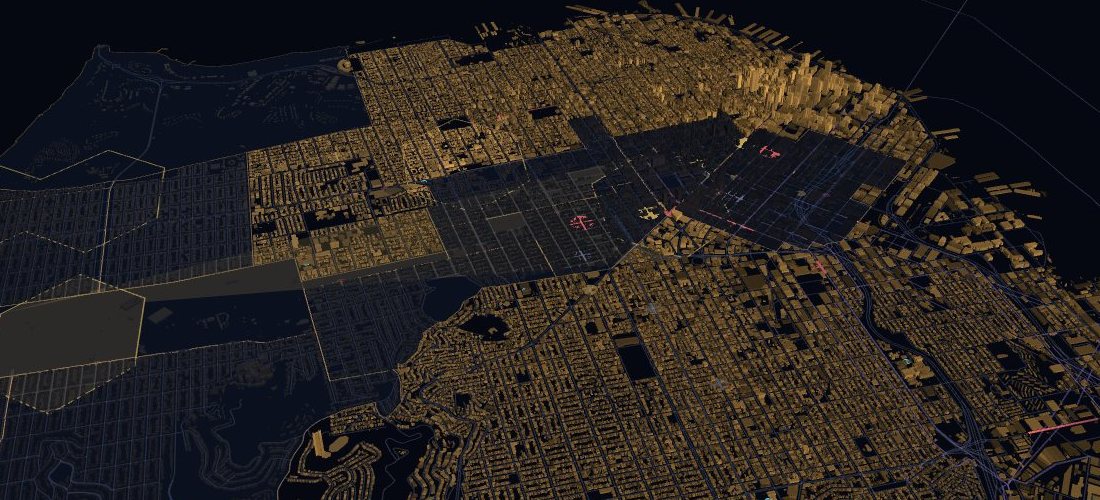
The interactive replay, 3:30 pm, 20 December 2025 With power Reported dark
Saturday, 20 December 2025
One substation, a third of the city
A few firefighters at one address changed the state of a third of the city, and within the hour the city, in its changed state, was sending those same firefighters dozens of calls. Between 1 and 4 pm the Fire Department answered 48 elevator rescues, where an ordinary Saturday afternoon brings about one. Effects ran from the smallest scale to the largest and back again. This is the behavior a world model has to capture.
- 1:09 pmFire at PG&E’s Mission substation. About 40,000 customers lose power.
- 2:22 pmFirefighters on scene.
- Within the hourCircuits de-energized for firefighters’ safety. The outage triples to about 130,000 customers.
- 6:26 pmThe fire is out.
- 63 hoursUntil full restoration.
Recorded: EAGLE-I county outage data (Oak Ridge National Laboratory); SFFD Calls for Service (DataSF); PG&E and news reporting.
Six capabilities
What no other world model can do
To our knowledge, no other learned world model can do any of these. Ours does all six, on a real city.
-
Rewind and test your own hypothesis, exactly
Roll the world back to any moment, change one thing and run it forward. Everything the change doesn’t reach is preserved byte for byte, so every difference is a consequence of the change.
San Francisco: the district outside the hypothesis’s reach was identical in every run.
-
Say why any single event happened
Every event carries its chain of causes, and a but-for test shows whether a given cause was necessary.
San Francisco: a Sunset electrical-hazard call that exists only because of the outage.
-
Build the macro world from micro events
City-wide phenomena emerge from millions of learned micro events, one entity at a time, rather than being modeled from the top down.
San Francisco: one model spans a substation fire, a third of the city in the dark, and individual emergency calls.
-
Spend compute only where something happens
Cost follows events, not area or frames, so a quiet street costs nothing.
San Francisco: twelve days of the city in about 78 seconds on one processor.
-
Give the same answer on one processor or millions
Results, including what the model learns, are bit-identical at any scale.
Verified on every change we make.
-
Learn from more data on ordinary processors
More data adds more small models, each trained where its part of the world runs, rather than a bigger network that only GPUs can train.
San Francisco: built, trained and run entirely on CPUs.
Held-out evidence
What the model learned
We trained the model on San Francisco’s records up to April 2025: 7.4 million unit dispatches going back to 2000, the 15-minute outage record, weather, fire stations and buildings. December 2025 was held out entirely. A quarter of an hour before the fire, we handed the model the city and let it generate the afternoon itself.
- 15× more elevator rescues where most homes are dark, learned on its own from 413 outages since 2018. Traffic collisions about 2×, medical calls about 1.3×.
- 36% of the evening’s incidents change when the world is rolled back to 3 pm and power is restored. Five runs, 31–39%. About 135 incidents prevented per run.
- 100% of incidents in Bayview, the one district the substation doesn’t serve, preserved exactly in every run. The same evening, byte for byte.
- 78s to run twelve days of San Francisco on one processor core. Retraining on fifteen months of history: about twelve minutes. No GPUs.
One incident, traced to its cause
At 5:59 pm in the Sunset, where 68% of homes were dark, the model’s rate of medical emergencies stood at 1.69 an hour, about half again its normal 1.11. A medical call came in, and an ambulance was sent. Replayed with power restored at 3 pm, the rate at that moment is 1.13 an hour, back to normal, and the call is prevented. The outage caused it, in the precise but-for sense, relative to what the model has learned.
- As it happened, 68% dark1.69/h
- Power restored at 3 pm1.13/h
- Normal rate1.11/h
Ask the world
Question the model in plain language
Ask why something happened, what a change would do, or which fix works best. Answers are drawn from the model’s own recorded events and results, not from general knowledge, and can take you to the place in the demo.
Questions to start with
- Why did the 5:59 pm medical call in the Sunset happen?
- Which restoration strategy prevents the most incidents?
- What changes if Station 1 has one more engine from 1 pm?
- How many elevator rescues did the model expect that afternoon?
Research
From a fire to a continent
Fire to Continent
An event-driven world model of San Francisco, built from the city’s own records and tested on the day a substation fire darkened a third of the city. What it learned, what it predicts when we act, and what it would take to model a continent.
Read the essayDoctrine
One truth. Many projections.
Facts live exactly once, in the record. A dashboard, a forecast, a world model and an answer are all views generated from it, and none of them is allowed to become it. The model on this site is a learner and a reader of the record, and its rewinds are possible worlds, not history.
Work with us
From one city to a continent
We are looking for partners: utilities and cities with outage, crew and dispatch records, groups with the compute to run continent-wide worlds, and researchers who want world models that can explain themselves.
- DataOutage, crew and dispatch records from utilities and cities. The city arrives as data; another city arrives the same way.
- ComputeThe processors to run continent-wide worlds. Regions run on separate machines and still give bit-identical answers.
- ResearchColleagues who want world models that can explain themselves, and the problems that make them harder.